The rapid emergence of generative AI models and tools has fundamentally altered the business technology landscape. Business leaders across industries now face a pivotal inflection point: how to effectively implement these powerful capabilities while navigating organizational complexity and managing risk.
While the technology itself is revolutionary, the true challenge lies not in the adoption of generative AI but in transforming how organizations operate to leverage its potential. As enterprises embark on this journey, they must recognize that successful implementation requires a strategic, measured approach focused on solving concrete business problems rather than chasing technological novelty.
This article outlines a pragmatic framework for enterprise leaders seeking to implement generative AI effectively. By approaching implementation through incremental transformations, balanced governance, and organizational readiness, companies can start capturing value from generative AI while building capabilities for more ambitious applications.
Understanding AI from a Management Perspective
For executives navigating the AI landscape, clarity is essential. While technical definitions abound, what matters for business leaders is developing the right mental models to make informed decisions.
Demystifying AI Types
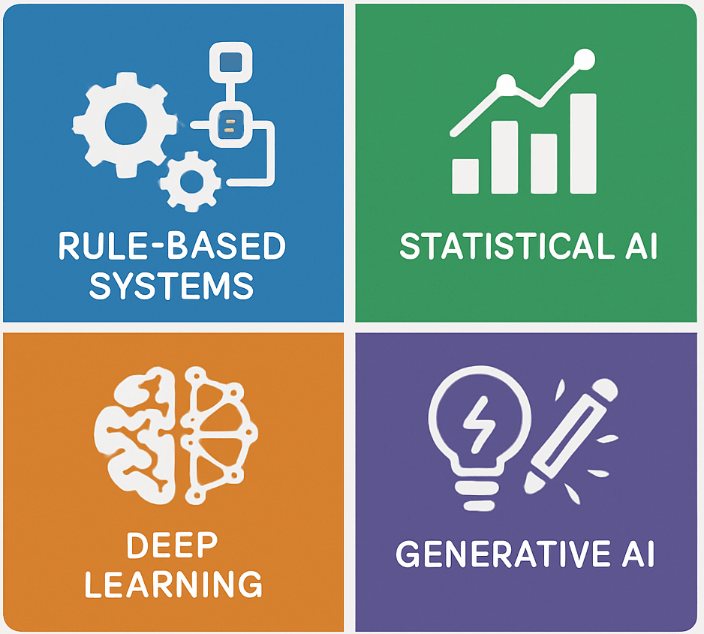
From a management perspective, AI can be understood through four key categories:
- Rule-based systems: These traditional AI systems follow programmed if-then statements. While limited in scope, they remain useful for well-defined, structured problems in domains like prescriptions or loan approvals.
- Statistics: These approaches work exceptionally well with numeric data organized in spreadsheets. They're particularly valuable for analyzing trends, forecasting, and making predictions based on historical patterns.
- Deep learning: These systems analyze vast amounts of labeled data to identify patterns beyond human perception. They power capabilities like image recognition, sentiment analysis, and natural language understanding.
- Generative AI: The newest frontier, these systems can create new content—text, images, code—based on learned patterns. They appear intelligent but are actually predicting the most likely next word, pixel, or element based on training data.
The Intelligence Paradox
Despite the term "artificial intelligence," it's crucial to understand that AI systems aren't truly intelligent. As MIT's Aude Oliva suggests, they might be better characterized as "artificial idiots"—powerful at specific tasks but lacking true understanding or context.
This doesn't diminish their value. AI systems can act intelligently within their domains, delivering tremendous business value when properly deployed. The key is recognizing their limitations and implementing appropriate guardrails for when they make mistakes—much as we do with human employees.
Business-First, Technology-Second
The most successful AI implementations begin not with technology but with business problems. As Matthew Evans of Airbus notes, "Strictly speaking, we don't invest in AI or natural language processing or image recognition. We are always investing in a business problem."
This perspective shift is vital: AI provides zero value to your company on its own. Value emerges only when the technology transforms business operations, customer experiences, or products and services. The most effective approach targets four key areas of opportunity:
- Creating emotionally engaging, personalized customer experiences
- Enhancing operations with greater adaptability and efficiency
- Evolving business models, such as turning products into services
- Improving employee experiences to boost satisfaction and productivity
The Progressive Implementation Approach
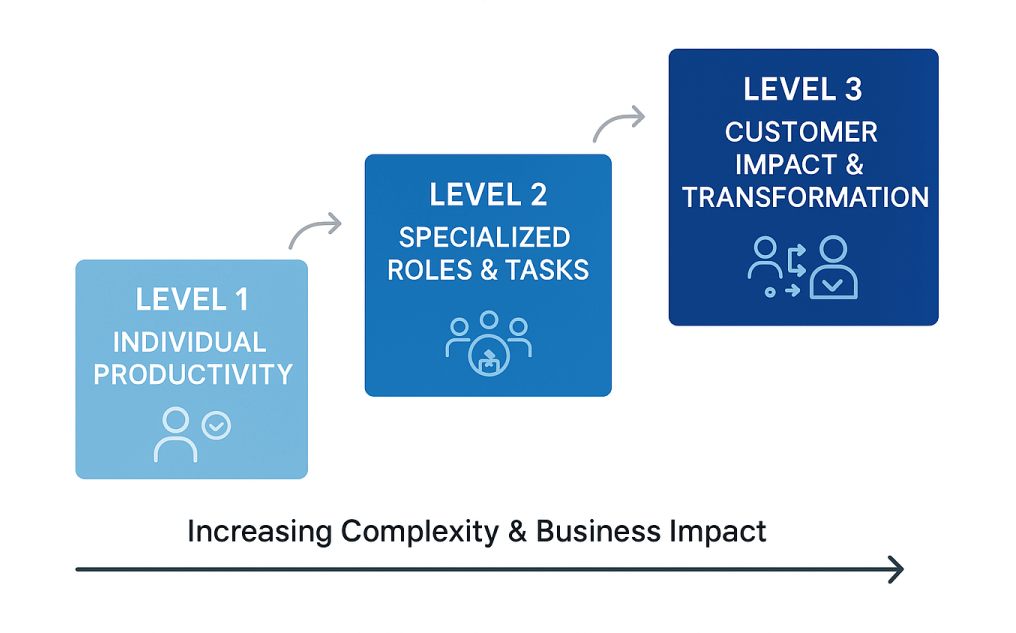
Implementing generative AI enterprise-wide requires a methodical approach that builds capability while managing risk. Rather than pursuing dramatic organizational transformation immediately, successful companies adopt what we might call "small t transformations"—incremental changes that deliver immediate value while building toward larger opportunities.
The Three-Level Implementation Model
Research reveals a clear pattern among organizations effectively implementing generative AI:
Level 1: Individual Productivity
At this foundational level, companies focus on enhancing individual employee productivity through generative AI tools. This typically involves:
- Providing access to approved, secure LLM interfaces
- Creating private versions of generative AI tools trained on company knowledge
- Enabling simple tasks like summarization, drafting, and information retrieval
This approach delivers immediate value with minimal risk while allowing employees to develop comfort with the technology.
Level 2: Specialized Roles and Tasks
As organizations build confidence, they progress to transforming specific roles and processes:
- Call center support with real-time AI assistants
- Coding assistance and documentation generation
- Sales enablement through intelligent content creation
At this level, humans typically remain in the loop for review and oversight, particularly for higher-risk contexts.
Level 3: Direct Customer Impact and Process Transformation
The most advanced implementations directly engage customers or transform entire business processes:
- Conversational interfaces for customer service
- Fully automated content generation for personalized marketing
- Integration of generative capabilities into core products and services
Starting Small to Go Big
This progressive approach resembles "putting a tire on a car"—tightening each bolt a little at a time rather than one completely and then the next. By implementing in manageable increments, organizations:
- Develop internal competency with generative AI
- Build risk management capabilities progressively
- Create positive examples that reduce organizational resistance
- Identify the most promising opportunities for larger transformations
Consider H&M's approach to generative AI in fashion retail. They began with internal productivity tools, progressed to specialized applications in design and marketing, and now are exploring customer-facing applications—each step building on lessons from the previous implementation.

Implementation Approaches: Finding Your Path Forward
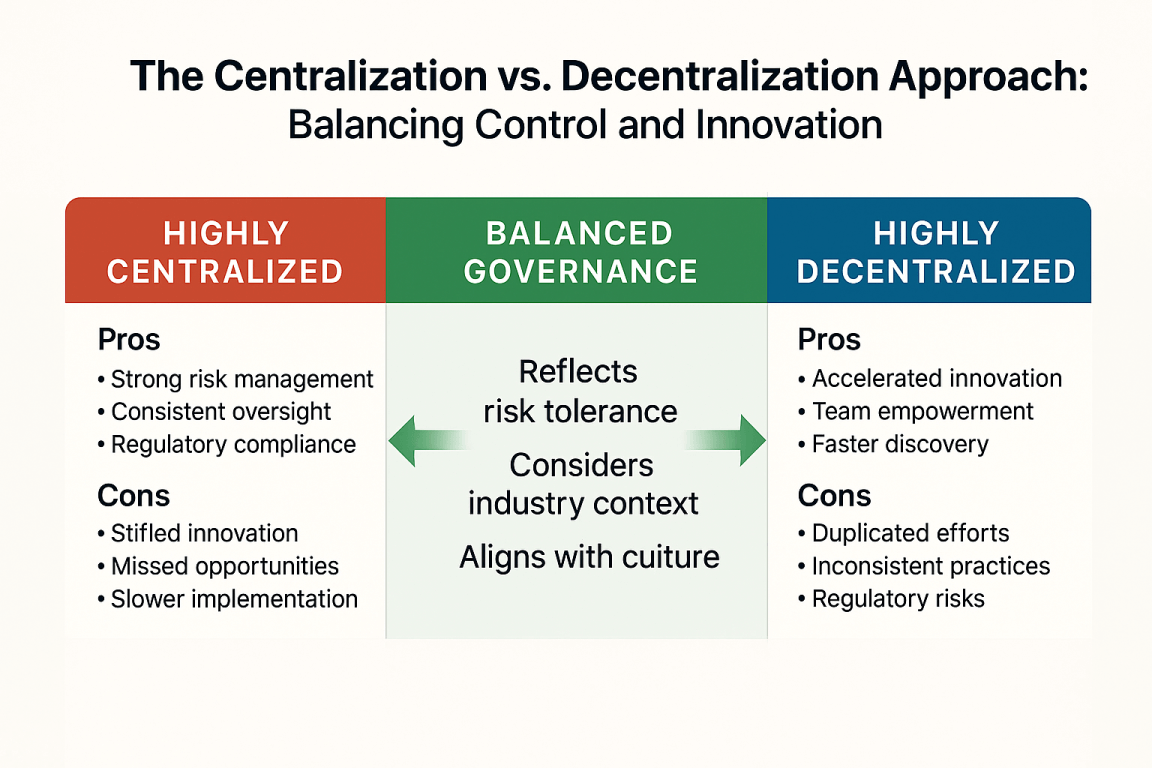
The Centralization vs. Decentralization Approach: Balancing Control and Innovation
At one end of the spectrum lies a highly centralized approach: tight control over AI initiatives with significant oversight, often managed through a central AI committee or office. This approach excels at risk management but can stifle innovation and miss opportunities visible only to those closest to specific business problems.
At the opposite end lies a decentralized strategy: empowering teams throughout the organization to experiment with generative AI with minimal central oversight. This approach accelerates innovation and discovery but risks duplication of effort, inconsistent practices, and potential regulatory or reputational exposure.
Most enterprises need to find a balanced position that reflects their risk tolerance, industry context, and organizational culture.
This practical framework acknowledges that generative AI, while powerful, isn't always the most efficient solution to every business problem.
Evaluating Potential Generative AI Applications
When considering where and how to apply generative AI in your organization, ask these key questions:
Business Impact Assessment
- How accurate must the solution be?
- What's the cost of being wrong?
- Is the application low-risk (marketing messages) or high-risk (medical diagnosis)?
Technical Feasibility Evaluation
- Do we need to understand how the AI reached its conclusion?
- Are we operating in regulated environments requiring transparency?
- Will stakeholders demand explanations of AI decisions?
Operational Requirements
- Do we need the same answer every time for the same input?
- Is variability in outputs acceptable or even desirable?
- How will we measure quality in scenarios with multiple valid answers?
Data and Security Considerations
- Does the application involve sensitive or proprietary information?
- What controls are needed to protect data privacy?
- Have we evaluated vendor data handling practices?
Effective implementation isn't just about individual projects—it's about building organizational capabilities through sequential wins:
- Quick wins first: Identify low-risk, high-visibility opportunities.
- Capability Building: Develop foundational elements that support multiple use cases.
- Skill Development: Create learning opportunities through hands-on projects.
- Progressive Expansion: Move from internal to customer-facing applications as confidence grows.
- Continuous Reassessment: Regularly review your approach based outcomes.
Organizations that find the right balance between structured planning and practical experimentation position themselves to capture value quickly while building the foundation for scaling generative AI capabilities across the enterprise.
Preparing Your Organization and Workforce
The success of generative AI initiatives depends as much on people as it does on technology. Even the most sophisticated AI implementation will fail if your organization isn't culturally prepared to embrace it. This critical human dimension requires deliberate attention to cultural readiness, skill development, and addressing legitimate concerns about AI's impact on jobs and work.
Addressing Cultural Readiness and Resistance
Organizations implementing generative AI often encounter varied reactions—from enthusiasm to anxiety to outright resistance. These reactions stem from legitimate questions:
- What happens when AI can perform tasks as well as or better than human experts?
- Will AI devalue human expertise that took years to develop?
- How will roles and responsibilities change as AI capabilities expand?
Rather than dismissing these concerns, leading organizations address them head-on by:
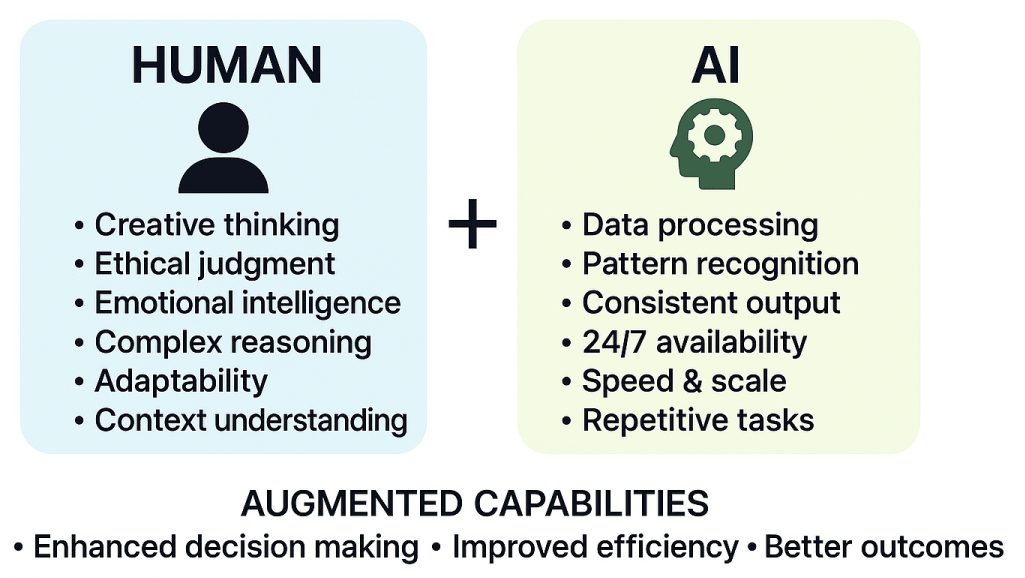
- Emphasizing augmentation over replacement: Framing AI as a tool that enhances human capabilities rather than a replacement for human judgment
- Creating space for humility: Acknowledging that in some domains, AI may outperform humans on specific tasks, while emphasizing that human judgment remains essential
- Establishing ethical guidelines: Developing clear principles about how AI will be used in ways that align with organizational values
Making AI Augment Rather Than Replace Human Capabilities
The most successful implementations focus on how AI can reduce cognitive load and handle routine tasks while allowing humans to focus on higher-value activities. Examples include:
- Content creation: AI can generate initial drafts or suggest headlines, while humans provide strategic direction and final polish
- Data analysis: AI can identify patterns and anomalies, while humans interpret their significance and make decisions
- Customer service: AI can handle routine inquiries, while humans manage complex or emotionally sensitive situations
- Coding: AI can suggest code snippets and handle documentation, while humans focus on architecture and problem-solving
The result? Creative professionals found that AI freed them to focus on truly creative work while handling mundane tasks. Most importantly, they "can't see themselves going back to the old way" of working.
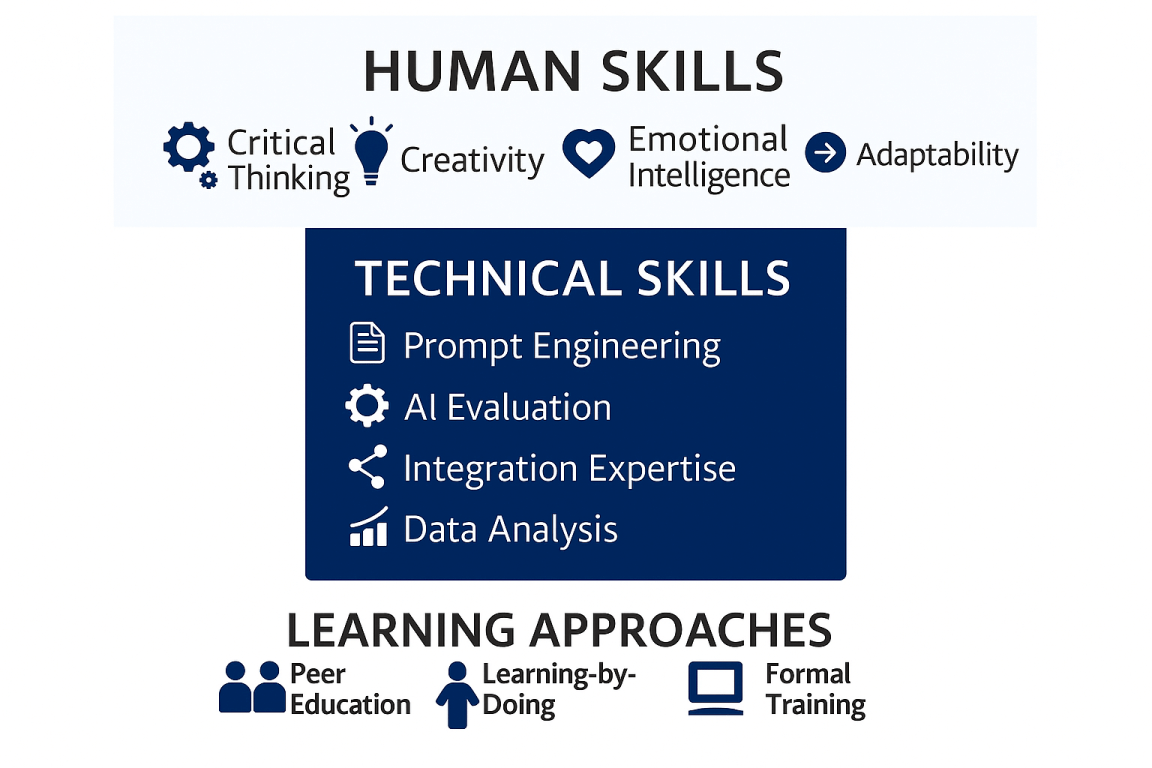
Developing Skills and Capabilities
Research suggests that as AI advances, 46% of jobs may see 50% of their tasks affected by automation. Rather than creating anxiety, this finding should prompt proactive skill development:
Technical Skills
- Prompt engineering: Learning how to effectively instruct AI systems
- AI evaluation: Developing the ability to assess AI outputs for quality and appropriateness
- Integration expertise: Understanding how to combine AI with existing workflows and systems
Human Skills
- Critical thinking: Evaluating AI outputs and knowing when to override them
- Creativity: Directing AI toward novel applications and solutions
- Emotional intelligence: Managing aspects of work where human connection remains essential
Learning Approaches
- Peer education: Creating forums where employees share discoveries and techniques
- Learning-by-doing: Providing safe spaces to experiment with AI applications
- Formal training: Developing structured programs for key capabilities
Measuring Progress and Impact
To monitor how well your organization is adapting to generative AI, track metrics in four key areas: Adoption Metrics
- Percentage of employees actively using AI tools
- Variety of use cases across departments
- Volume of AI-assisted work products Productivity Metrics
- Time saved on routine tasks
- Volume of work produced
- Quality improvements in outputs Skill Development Metrics
- Completion of AI-related training
- Self-reported confidence with AI tools
- Sophistication of AI applications Cultural Metrics
- Employee sentiment toward AI initiatives
- Willingness to share AI discoveries
- Proactive suggestions for new AI applications
Organizations that excel at preparing their workforce don't just focus on technology adoption—they create the conditions for humans and AI to develop a productive partnership that enhances both individual capabilities and organizational performance.
By investing in cultural readiness, highlighting augmentation over replacement, and developing critical skills, enterprises create an environment where generative AI becomes a welcomed enhancement to human potential rather than a threat to it.
Conclusion: Starting Your Generative AI Journey
The implementation of generative AI in the enterprise represents a significant opportunity, but success depends far more on how you approach the transformation than on the technology itself. As we've explored throughout this article, organizations that succeed with generative AI focus on solving business problems first, implement progressively, balance governance approaches, and prepare their workforce effectively.
Begin with Business Problems, Not Technology The most successful generative AI implementations start with clearly defined business challenges. Whether enhancing customer experience, improving operations, evolving business models, or enhancing employee productivity, maintain a relentless focus on value creation rather than technology deployment.
Embrace Progressive Implementation Start with "small t transformations" that deliver immediate value while building capabilities for larger changes. Begin with individual productivity tools, progress to specialized roles and tasks, and then expand to customer-facing applications and process transformation as your organization's AI maturity increases.
Find Your Balance Between Control and Innovation There is no one-size-fits-all governance approach for generative AI. Assess your organization's risk tolerance, industry context, and culture to find the right balance between centralized oversight and decentralized experimentation. Establish clear evaluation criteria that consider accuracy requirements, explainability needs, consistency demands, and data sensitivity.
Invest in Your People Technology deployment is only half the equation. Address cultural readiness, frame AI as augmenting rather than replacing human capabilities, and invest in developing both technical and human skills. Create learning communities that accelerate adoption through shared discoveries and collaborative problem-solving.
Start Now, But Start Wisely While there's urgency to begin implementing generative AI, rushing without proper preparation leads to failed projects and organizational resistance. The organizations that will gain competitive advantage are those that start now but implement methodically, learning and adapting as they go.
As with any significant technological shift, implementing generative AI isn't a destination but a journey. The capabilities will continue to evolve rapidly, but by building the right organizational foundations now, enterprises can position themselves to capture value today while preparing for the even greater opportunities tomorrow will bring.
Remember: Artificial intelligence can seem intelligent, but the true intelligence lies in how your organization implements it.